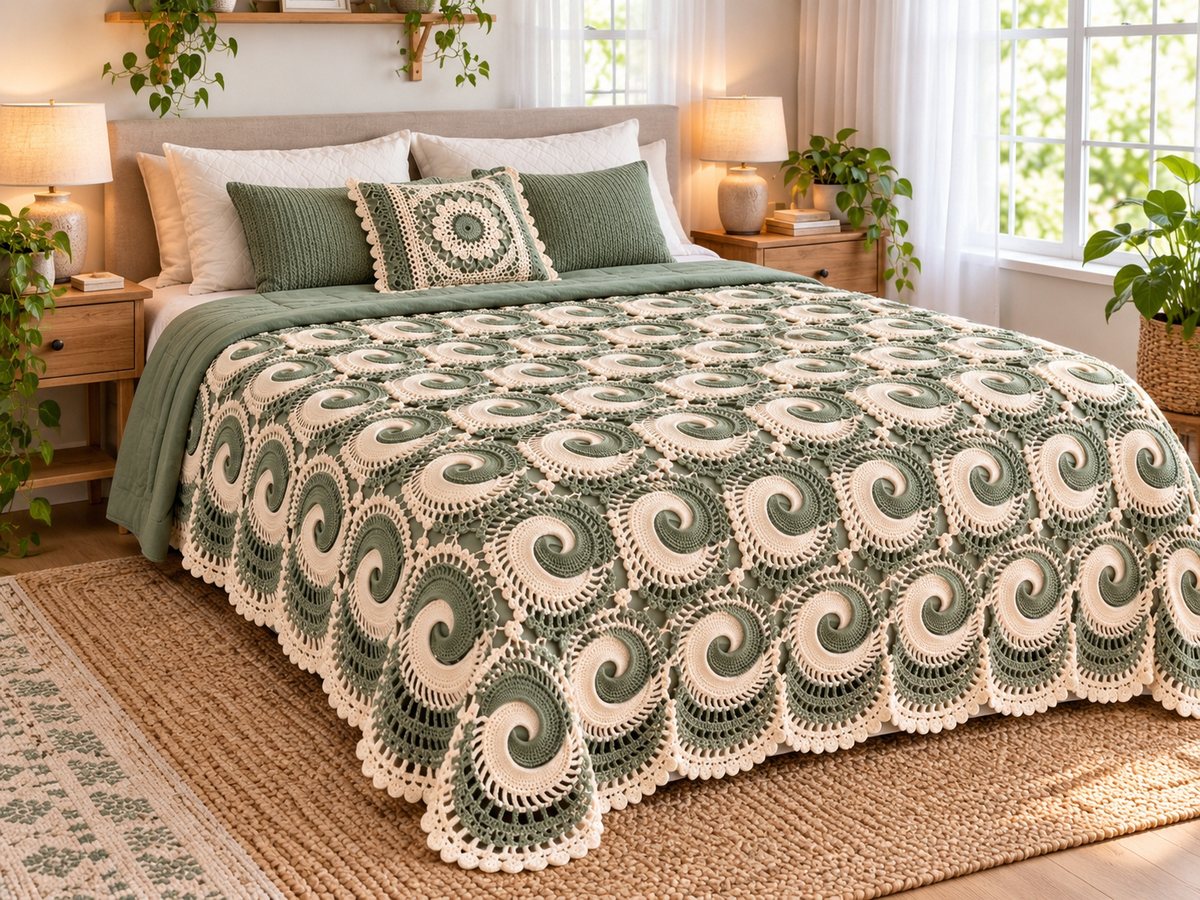
Two colors, one swirl. Every round motif in this sage green and cream bedspread has a spiral that turns like a wave, with a ring of fans and lace loops around it. Laid out in offset rows, the motifs flow across the bed.
The pattern uses only basic stitches. The one new skill is moving the color change in each round to make the spiral. Make one motif and you will see how it works.
What you need
- Yarn: worsted weight (medium 4) cotton in 2 colors: sage green (#7E9B7A) and cream (#F3EBDC).
- Hook: 4.5 mm (US 7). Go up or down a size if your motif is too tight or floppy.
- Tools: tapestry needle, scissors, stitch markers, blocking mats and pins.
- How much yarn? Estimate for a queen bedspread (about 119 motifs): 2,500 m (2,700 yd) of each color, including joining and the border. For a better number, make and weigh one motif, multiply by the motif count, then add 15%.
Abbreviations and size
- ch chain
- sl st slip stitch
- sc single crochet
- hdc half double crochet
- dc double crochet
- inc 2 sc in the same stitch
- dec sc 2 together
- blo back loop only
- sp space
- st(s) stitch(es)
- magic ring adjustable starting loop
Motif size: about 16 cm (6.3 in) across after blocking.
Layout: rows of 9 and 8 motifs, alternating, so each row sits in the gaps of the row above. 14 rows (7 of 9 and 7 of 8) make 119 motifs and a bedspread of about 145 x 195 cm. For a lap throw use 6 rows (39 motifs).
How to crochet the spiral motif
Every motif is a round disc with a swirl in the middle, then a ring of fans, lace loops and shells. The swirl comes from the color change: in every round the cream section moves 2 stitches further along, so the cream and sage bands turn like a spiral. Work every round with the right side facing you and do not turn. Carry the color you are not using along the back and crochet over it.
- Round 1 (cream): Make a magic ring. Ch 1, 6 sc in the ring. Join with a sl st to the first sc. [6 sc]
- Round 2: Ch 1, 2 sc in each st around. Join. [12 sc] Work sts 1–6 in cream and sts 7–12 in sage.
- Round 3: Ch 1, *sc in the next st, inc in the next st; repeat from * 5 more times. Join. [18 sc] Work sts 1–2 in sage, sts 3–11 in cream, sts 12–18 in sage.
- Round 4: Ch 1, *sc in the next 2 sts, inc in the next st; repeat from * 5 more times. Join. [24 sc] Work sts 1–4 in sage, sts 5–16 in cream, sts 17–24 in sage.
- Round 5: Ch 1, *sc in the next 3 sts, inc in the next st; repeat from * 5 more times. Join. [30 sc] Work sts 1–6 in sage, sts 7–21 in cream, sts 22–30 in sage.
- Round 6: Ch 1, *sc in the next 4 sts, inc in the next st; repeat from * 5 more times. Join. [36 sc] Work sts 1–8 in sage, sts 9–26 in cream, sts 27–36 in sage.
- Round 7: Ch 1, *sc in the next 5 sts, inc in the next st; repeat from * 5 more times. Join. [42 sc] Work sts 1–10 in sage, sts 11–31 in cream, sts 32–42 in sage. Fasten off sage.
- Round 8 (fans, cream): Ch 1, *sc in the next st, skip 2 sts, 5 dc in the next st, skip 2 sts; repeat from * 6 more times. Join. [7 sc and 7 fans of 5 dc]
- Round 9 (lace loops, cream): Sl st to the middle dc of the first fan. *Ch 5, sc in the middle dc of the next fan; repeat from * 5 more times. Ch 5 and join to the first sl st. [7 ch-5 loops]
- Round 10 (shells): In each ch-5 loop work (sc, hdc, 3 dc, hdc, sc). Work the shells in loops 1–4 in cream. Change to sage and work loops 5–7. Join and fasten off. [7 shells, 49 sts]
Rule to remember: the number in the brackets is your check. If the count is off, the cream band will not turn evenly, so fix it before you go on.
Join the motifs
- Make the motifs and block them flat before you join.
- Lay them in rows of 9 and 8, offset by half a motif. Every motif touches 6 neighbors.
- Join as you go: in Round 10, where two shells touch, work the middle dc of the shell like this: drop the loop, insert the hook into the middle dc of the neighbor shell, pull the dropped loop through and carry on.
- Join the motifs into rows first, then join the rows. Keep the joins loose so the bedspread stays soft.
- The spaces between the motifs show the bed sheet through. Put a sage green sheet under the bedspread to make the lace stand out.
Border
- Round 1 (cream): Join cream at any outer point. Ch 1, sc evenly around the zigzag edge, about 3 sc in each shell, and 2 sc in each space between shells. Join.
- Round 2 (scallops): Ch 1, sc in the first st. *Skip 1 st, 5 dc in the next st, skip 1 st, sl st in the next st; repeat from * around. Fasten off and weave in the ends.
Matching lace cushion
- Join 4 motifs in a 2 x 2 block with cream. The panel is about 32 cm across.
- Work Border Round 1 and Round 2 around the outside.
- Make the back from sage or cream fabric. Sew the front and back wrong sides together on three sides, insert a 30 cm (12 in) pillow form and close the last side.
Tips for success
- Check your gauge. One motif should be about 16 cm across after blocking.
- Mark Round 1 with a stitch marker so you can see where the color change moves.
- Use one dye lot of cream and buy extra. Cream cotton shows dye differences.
- Weave the ends as you go. 119 motifs have a lot of ends.
- Work in small steps. Make 2 motifs a day and all 119 are done in about 8 weeks. Joining and the border take 2 to 3 more weeks.
Ways to change this pattern
- Reverse colors: cream spiral on a sage background, or the other way round.
- Blue and white: denim blue with cream for a fresh look.
- Single color: make all motifs in cream for a classic lace bedspread.
- Lap throw: 39 motifs, about 112 x 90 cm.
Frequently asked questions
What skill level do I need?
Intermediate. You need sc, hdc and dc and you must be able to change color in a round. Make one practice motif first.
How long does it take?
About 40 minutes per motif. All 119 motifs take about 80 hours, plus about 15 hours for joining and the border. At 8 to 10 hours a week, plan on 10 to 12 weeks.
What is the best yarn?
Soft mercerized cotton shows the swirl and the lace best. Choose a smooth yarn, not a fuzzy one.
How do I wash it?
Hand wash or use a gentle cycle in cool water and dry flat. Do not hang a wet lace bedspread, because it will stretch.
Can I sell things I make from this pattern?
Yes, you can sell finished items. Please credit this website as the designer and do not copy or share the written pattern.
More from the blog
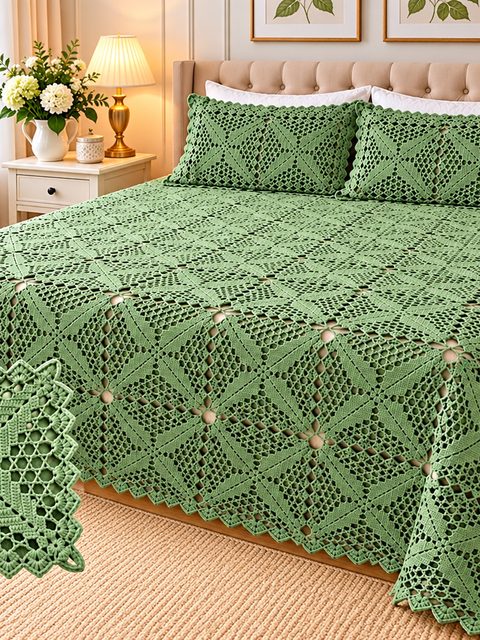 Crochet Sage Lace Bedspread — Free Crochet Pattern
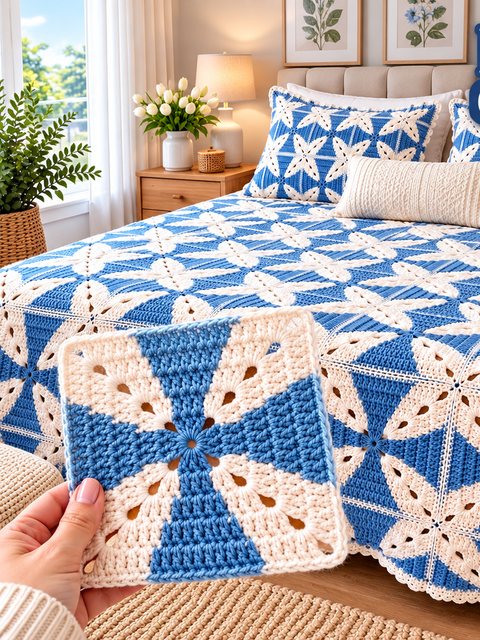 Crochet Blue and White Pinwheel Bedspread — Free Crochet Pattern
 See all free crochet patterns