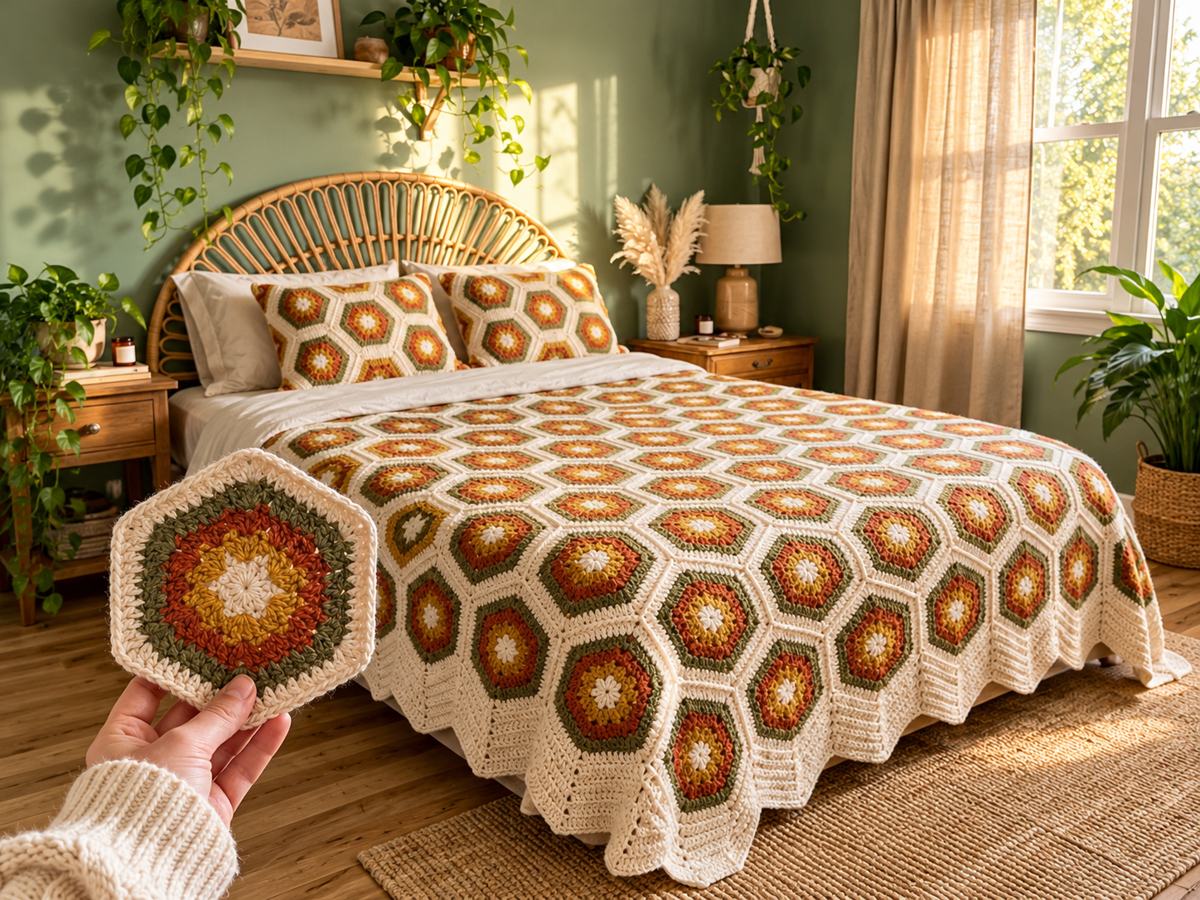
This hexagon bedspread is the kind of project that turns a plain bed into the focus of the room. Each motif is a small, easy hexagon with cream, mustard, rust and olive rings. Joined together, the hexagons make a warm honeycomb that looks great against a sage green wall.
Every motif is worked in the same simple rounds, so the pattern is easy to learn and easy to take with you. You only need basic stitches: chain, slip stitch, single crochet and double crochet.
What you need
- Yarn: worsted weight (medium 4) cotton or soft acrylic in 5 colors: cream (main), mustard, rust, olive green and a spare cream for the border.
- Hook: 5 mm (H-8). Go up or down a size if your motif is too tight or too floppy.
- Tools: tapestry needle, scissors, stitch markers, blocking mats and pins.
- How much yarn? Make one finished motif, weigh it, multiply by the number of motifs, then add 15% for joining and the border. This is more accurate than any guess.
Abbreviations and size
- ch chain
- sl st slip stitch
- sc single crochet
- dc double crochet
- sp space
- st(s) stitch(es)
- picot ch 3, sl st into the 1st ch
- magic ring adjustable starting loop
Motif size: about 20 cm (8 in) across, flat side to flat side, after blocking.
Motifs needed: about 120 for a full or queen cover (180 x 210 cm). Make 70 for a lap throw.
How to crochet the hexagon motif
Work every round with the right side facing you. Join each round with a slip stitch to the top of the first chain-3. The chain-3 at the start of a round counts as 1 dc.
- Round 1 (cream): Make a magic ring. Ch 3, 1 dc in the ring, ch 2. *2 dc in the ring, ch 2. Repeat from * 4 more times. Join. [12 dc, 6 corner spaces]
- Round 2 (mustard): Join mustard in any corner space. Ch 3, (1 dc, ch 2, 2 dc) in the same space. Work (2 dc, ch 2, 2 dc) in each corner space around. Join. [24 dc]
- Round 3 (mustard): Slip stitch to the next corner space. Ch 3, (1 dc, ch 2, 2 dc) in the space. *Dc in each of the next 4 sts, (2 dc, ch 2, 2 dc) in the next corner space. Repeat from * around. Join. [48 dc]
- Round 4 (rust): Join rust in any corner space. Make the same corner, then dc in each stitch along every side. Join. [72 dc]
- Round 5 (rust): Repeat Round 4 with 12 dc on each side between corners. [96 dc]
- Round 6 (olive): Repeat Round 4 with 16 dc on each side. [120 dc]
- Round 7 (olive): Repeat Round 4 with 20 dc on each side. [144 dc]
- Round 8 (cream border): Repeat Round 4 with 24 dc on each side. Fasten off and weave in the ends. [168 dc]
Rule to remember: in every round you work (2 dc, ch 2, 2 dc) in each corner space and 1 dc in every stitch along the sides. Each side gets 4 stitches longer each round. If your stitch count is off, find the mistake before the next round.
Block and lay out the hexagons
Pin each motif flat to your blocking mat, steam it lightly and let it dry. Blocked hexagons fit together without gaps. Then lay them on the floor in rows. Alternate the colors so that no two rust rings or two olive rings sit next to each other in a way that looks heavy. Take a photo of the layout so you can copy it later.
Join the hexagons
- Hold two motifs with right sides together. Whipstitch along one side through the back loops only with cream yarn.
- Join the motifs into long rows first, then join the rows to each other.
- Where three corners meet, make one small stitch through all three corners so the seam stays flat.
- Keep your joining stitches loose. Tight seams make the bedspread stiff.
Scalloped border
- Round 1: Join cream at any outer point. Ch 1, sc evenly around the zigzag edge, working 2 sc in each outer point and skipping 1 st in each inner corner. Join.
- Round 2: Ch 3, dc in each stitch around, working (2 dc, ch 1, 2 dc) in each outer point. Join.
- Round 3 (scallops): *Skip 2 sts, work (3 dc, picot, 3 dc) in the next st, skip 2 sts, sc in the next st. Repeat from * around. Join, fasten off and weave in all ends.
Matching pillow covers (make 2)
- Make 7 hexagons: 1 in the middle and 6 around it. Join them as in the bedspread.
- Work 1 round of sc around the outer edge, then the scallop round from the border.
- Sew the front to a plain cushion cover, or crochet a simple dc back panel and sew the two pieces together around 3 sides. Add your pillow, then sew the 4th side closed.
Tips for success
- Check your gauge. Make one motif before you start the bedspread. If it is much bigger than 20 cm, use a smaller hook.
- Count every round. Wrong counts make hexagons curl or ruffle.
- Use one dye lot for each color, and buy extra cream. It is used for the center, the border and the joining.
- Work in small steps. Make 5 motifs a week and the bedspread is finished in about 6 months of easy evenings, or faster if you crochet daily.
- Weave ends as you go. Doing 120 motifs of ends at the end is a big job.
Common mistakes to avoid
- Skipping the blocking step. Unblocked hexagons curl and do not match.
- Pulling the joining yarn too tight, which creates ridges.
- Changing colors in the wrong order, so the rings are different on each motif.
- Forgetting to count the stitches along the sides.
- Using a very fuzzy yarn. It hides the pretty rings.
Ways to change this pattern
- Neutral version: cream with grey and beige rings.
- Baby blanket: make only 30 hexagons with soft pastel colors.
- Bold version: use one dark color for every second motif.
- Table runner: join 6 hexagons in a row.
- Bigger motifs: add Rounds 9 and 10 for a 25 cm hexagon and use fewer motifs.
Frequently asked questions
What skill level do I need?
If you can make a double crochet and a magic ring, you can do this pattern. The rounds repeat, so it is a good first big project.
How long does it take?
Each hexagon takes about 40 to 60 minutes. A full bedspread takes most crocheters 6 to 8 weeks of regular work, plus time for joining.
What is the best yarn?
Mercerized or soft cotton gives clean stitches and is easy to wash. Soft acrylic is a good low-cost choice.
How do I wash it?
Machine wash on a gentle cycle in cold water, or hand wash. Dry it flat. Do not hang it, because the weight will stretch the stitches.
Can I make it smaller or bigger?
Yes. Use about 70 motifs for a lap throw, 120 for a full or queen cover and 150 for a king. Always measure your bed first.
Can I sell things I make from this pattern?
Yes, you can sell finished items. Please credit this website as the designer and do not copy or share the written pattern.