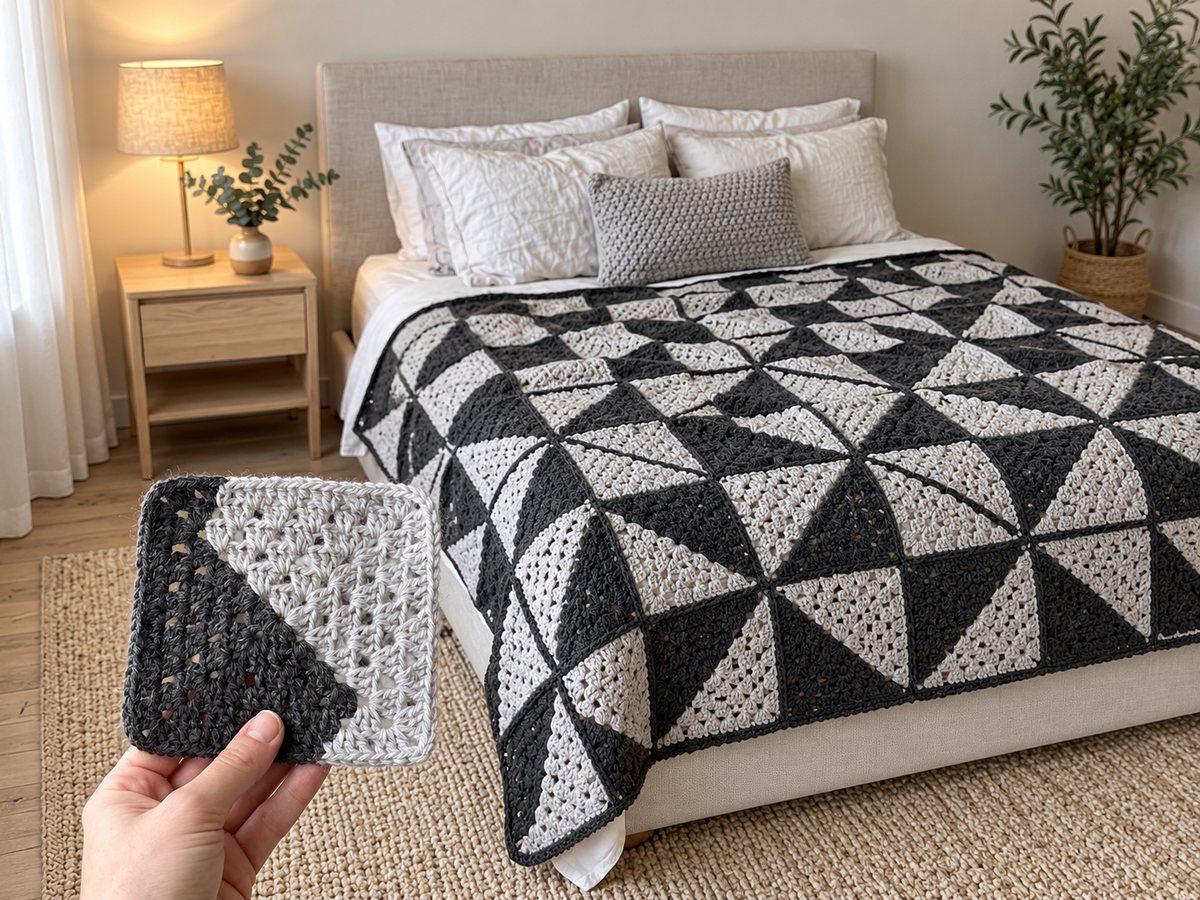
This monochrome blanket is all about bold shapes. Every square is split along a sharp diagonal: one half in solid charcoal, the other half in airy light grey lace. Turn the squares a quarter turn each and they make a pinwheel of big black and white triangles across your bed.
Each square is made in one piece, corner to corner, so there is no sewing between the two halves. You only need basic stitches: chain, slip stitch, single crochet, half double crochet and double crochet. Make one practice square first to learn the color change. After that, every square is the same.
What you need
- Yarn: worsted weight (medium 4) cotton or cotton blend in 2 colors: charcoal grey (main color, joining and border) and light grey.
- Hook: 4 mm (G-6). Go up or down a size if your square is too tight or too floppy.
- Tools: tapestry needle, scissors, stitch markers, blocking mats and pins.
- How much yarn? Estimate for a queen blanket with two cushion fronts: about 2,700 m (2,950 yd) charcoal and 1,250 m (1,370 yd) light grey. For a better number, make one finished square, weigh it, multiply by the number of squares, then add 15% for joining and the border.
Abbreviations and size
- ch chain
- sl st slip stitch
- sc single crochet
- hdc half double crochet
- dc double crochet
- sp space
- st(s) stitch(es)
- block one small square of stitches worked in a ch-3 space
Square size: about 15 cm (6 in) across after blocking, with the border round.
Squares needed: 130 for the blanket (10 across and 13 down, about 155 x 200 cm with the border) plus 18 for two cushion fronts, so 148 in total. Make 48 (6 x 8) for a lap throw.
How to crochet the split square
Each square is worked corner to corner in rows, and you turn after every row. Charcoal blocks are solid (3 dc). Light grey blocks are open (dc, ch 1, dc). Every block starts with 3 chains, called the ch-3 sp, and the next row grows from these spaces. The square has 8 blocks along each side.
Part 1: charcoal half (Rows 1–8, adding a block each row)
- Row 1: With charcoal, ch 6. Dc in the 4th ch from the hook and in each of the next 2 ch. Turn. [1 block]
- Row 2: Ch 6. Dc in the 4th ch from the hook and in each of the next 2 ch (first block made). Sl st in the ch-3 sp of the first block of the row below. Ch 3, 3 dc in the same sp. Turn. [2 blocks]
- Rows 3–8: Ch 6. Dc in the 4th ch from the hook and in each of the next 2 ch. Sl st in the ch-3 sp of the first block of the row below, ch 3, 3 dc in the same sp. *Sl st in the ch-3 sp of the next block of the row below, ch 3, 3 dc in the same sp. Repeat from * until you have made one block for each block of the row below. Turn. [Row 3 has 3 blocks, Row 4 has 4, and so on, up to 8 blocks in Row 8]
Part 2: light grey half (Rows 9–15, one block less each row)
- Row 9: Fasten off charcoal and turn. Join light grey with a sl st in the top of the first dc. Sl st in each of the next 2 dc and in the ch-3 sp. Ch 3, (dc, ch 1, dc) in the same sp. *Sl st in the ch-3 sp of the next block, ch 3, (dc, ch 1, dc) in the same sp. Repeat from * 5 more times. Do not work into the last block of Row 8. Turn. [7 open blocks]
- Rows 10–15: Sl st in the dc, the ch-1 sp and the dc of the first block, then sl st in its ch-3 sp. Ch 3, (dc, ch 1, dc) in the same sp. *Sl st in the ch-3 sp of the next block, ch 3, (dc, ch 1, dc) in the same sp. Repeat from * until the row has one block less than the row below. Do not work into the last block of the row below. Turn. [Row 10 has 6 blocks, Row 11 has 5, Row 12 has 4, Row 13 has 3, Row 14 has 2, Row 15 has 1]. After Row 15, fasten off.
Part 3: border round (charcoal)
- Round 1: With the right side facing, join charcoal in any corner. Ch 1, 3 sc in the corner. *Work 3 sc along the edge of each block (3 sc in each ch-3 sp, and 1 sc in each dc and ch-1 sp at a dc end). That is 24 sc along the side. Work 3 sc in the next corner. Repeat from * 2 more times, then work 24 sc along the last side. Join with a sl st to the first sc. Fasten off and weave in the ends. [108 sc]
Rule to remember: the square has 8 blocks on the longest row (Row 8), then it gets smaller by 1 block every row. Count your blocks at the end of every row. If one row looks too long, find the mistake before you go on.
Block and lay out the squares
Pin each square flat to your blocking mat, steam it lightly and let it dry. Blocking makes every square the same size and opens the lace. Look at each square and find the charcoal corner: the corner where you made Row 1, which is the square corner of the charcoal triangle.
Lay the squares in 13 rows of 10 using the pinwheel layout. Repeat this block of 4 squares across and down:
- Top-left square: charcoal corner in the top-right.
- Top-right square: charcoal corner in the bottom-right.
- Bottom-right square: charcoal corner in the bottom-left.
- Bottom-left square: charcoal corner in the top-left.
Each square is turned a quarter turn from its neighbor, and the dark and light triangles join into pinwheels. Take a photo of your layout so you can always find your place again.
Join the squares
- Hold two squares with right sides together and match the corners. With charcoal, whipstitch along one side through the back loops only.
- Join the squares into 13 long rows of 10 first, then join the rows to each other.
- Where four corners meet, make one small stitch through all four.
- Keep your joining stitches loose. Tight seams make the blanket stiff. The charcoal seams will draw a neat dark outline around every triangle.
Border
- Round 1: Join charcoal at any corner. Ch 1, sc in each st around the whole blanket, with 1 sc in each seam and 3 sc in each outer corner. Join.
- Round 2: Ch 2 (does not count as a st), hdc in each st around, with 3 hdc in each corner st. Join.
- Round 3: Ch 1, sc in each st around, with 3 sc in each corner st. Join and fasten off. Weave in the ends.
Matching cushion covers (make 2)
- Make 9 squares for each cushion front. Lay them in 3 rows of 3 in the pinwheel layout and join them as you did for the blanket. The panel is about 46 x 46 cm.
- Work 1 round of sc around the outer edge with charcoal, with 3 sc in each corner.
- Make the back from charcoal or light grey cotton fabric, cut slightly smaller than the front. Place front and back wrong sides together, sew around three sides, insert a 40 x 40 cm (16 in) pillow form and close the last side.
Tips for success
- Check your gauge. Make one square before you start the blanket. It should be about 15 cm across after blocking.
- Keep your tension even. Open blocks and solid blocks should be the same size. If the light grey half comes out wider, use a hook 0.5 mm smaller for the light grey rows.
- Count every row. One missed block makes the square lopsided.
- Use one dye lot of charcoal and buy extra. It is used for the dark half, every seam and the border.
- Make every border the same. All squares should end with 108 sc, so the sides match when you join.
- Work in small steps. Make 3 squares a day and all 148 squares are done in about 7 weeks. Joining and the border take 2 to 3 more weeks.
- Weave ends as you go. Doing 148 squares of ends at the end is a big job.
Common mistakes to avoid
- Forgetting the ch 6 at the start of a row. The row will not grow into a new block.
- Working into the last block of the row below in Rows 9–15. The square will not get smaller correctly.
- Pulling the yarn tight at the color change. Keep this join loose.
- Skipping the blocking step. Unblocked squares curl and join unevenly.
- Turning the squares the wrong way in the layout. Check the pinwheels with a photo before you join.
- Using a very fuzzy yarn. It hides the lace and the sharp diagonal.
Ways to change this pattern
- Diamond version: instead of the pinwheel, turn the squares so the charcoal corners of four squares meet in the center of every block of 4 (top-left square: top-left, top-right square: top-right, bottom-right square: bottom-right, bottom-left square: bottom-left). The light triangles make big diamonds.
- Soft version: charcoal and cream, or navy and white.
- Lap throw: join 48 squares in 8 rows of 6. It measures about 90 x 120 cm.
- Baby blanket: join 30 squares in 6 rows of 5, about 75 x 90 cm.
Frequently asked questions
What skill level do I need?
Easy. If you can make a double crochet, a slip stitch and a chain, you can do it. Corner-to-corner blocks feel odd for the first two rows, so make a practice square first.
How long does it take?
Each square takes about 30 minutes. All 148 squares need about 75 hours, plus about 15 hours for joining and the border. At 10 hours a week, plan on 8 to 10 weeks.
What is the best yarn?
Cotton or a cotton blend gives crisp stitches and a sharp diagonal. Choose a smooth yarn, not a fuzzy one.
How do I wash it?
Hand wash or use a gentle cycle in cool water, then dry flat. Cotton can shrink a little, so avoid hot water.
Can I make it smaller or bigger?
Yes. Use 48 squares for a lap throw and 130 for a queen blanket. To size it for your bed, divide the bed measurements by your square size (15 cm).
Can I sell things I make from this pattern?
Yes, you can sell finished items. Please credit this website as the designer and do not copy or share the written pattern.